An earwax blockage can feel a bit like trying to hear with your head under the water at Winona Outdoor Pool. That feeling makes sense because something is blocking the path of sound through your ear canal. What may come as a surprise is that earwax can also cause a ringing or buzzing in your ear known as tinnitus.
How Earwax Blockages Cause Tinnitus
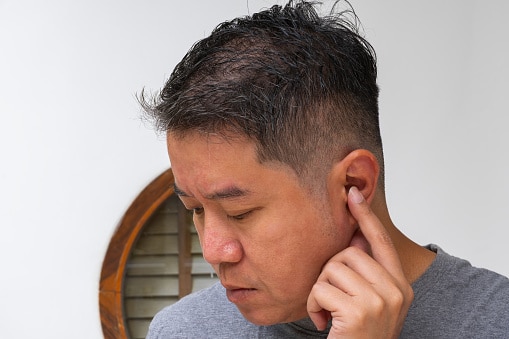
When earwax blocks sound from entering the ear, your auditory system doesn’t get the same amount of sound information that it’s used to. In response, your auditory system may generate its own noise in the form of ringing or buzzing.[1] You can think of the phenomenon as similar to how you might talk aloud to yourself when nobody else is home—like you’re filling the space where there is usually noise.
While tinnitus caused by an earwax blockage can be troublesome, it will likely resolve once the blockage is removed.
Removing Earwax Blockages Safely
Tinnitus arising from an earwax blockage will likely also present with muffled hearing, a sensation of ear fullness and possibly some balance issues. After we confirm that you have an earwax blockage, we can remove it using a special earwax scoop, suction, irrigation or a combination of all three. If you get regular wax blockages, we may recommend ear drops to soften the wax and a bulb syringe to remove it at home.
Many people reach for cotton swabs when they have an earwax blockage, but it’s crucial to avoid doing so. Sticking cotton swabs in your ears can damage the ear canal or tear the eardrum.
Knowing when tinnitus arises as a temporary symptom of an earwax blockage, and when it’s a sign of more permanent hearing damage, is an essential part of managing it. Our specialist at Alpine Ear Nose & Throat PC can conduct an ear exam and, if necessary, a hearing test to get to the bottom of your tinnitus and help you find the right treatment path forward.
[1] National Institute on Deafness and Other Communication Disorders. (2023). Tinnitus. National Institutes of Health. https://www.nidcd.nih.gov/health/tinnitus